
Housing development is often discussed in terms of construction timelines and completed units. Less visible, but equally critical, is the work that happens before construction begins. Pre-development is where projects are defined, risks are identified, and decisions that shape later phases of development are made.
Phoenix Youth Programs’ experience in Halifax illustrates practical tools and approaches used during the pre-development phase of a complex community housing project. This work responds to housing insecurity among youth and offers insight into how organizations can approach early-stage development in constrained and uncertain environments.
The approaches outlined here reflect key topics explored in the Centre’s knowledge-sharing series on housing. While the series as a whole spans multiple themes, this particular webinar session focused specifically on housing pre-development, including vision setting, site identification, governance design, risk analysis, space planning, and collaboration with external teams.
Setting a common vision
Establishing a shared project vision is a foundational step in housing pre-development.For Phoenix Youth Programs, this work emerged from its ongoing role supporting youth through housing and community-based services. Informed by the voices of youth, Phoenix sees the persistent and overwhelming challenges related to housing affordability, access, and system navigation for youth ages 16–24 and their families.
The multi-service housing centre concept brings together housing and services within a single development. The proposed project includes approximately 50 housing units, alongside shared spaces and partner-delivered supports. The vision developed over several years and was informed by feasibility work, internal discussions, and engagement with youth, staff, and community partners. A key lesson from this phase was the importance of clarity paired with flexibility. Mel Sturk, director of organizational development at Phoenix Youth Programs, emphasized the importance of being clear about intent without locking in details too early. This approach supported shared understanding and allowed the project to evolve as new information emerged.
Early feasibility work supported this process. Phoenix received support through the Centre’s Nova Scotia Community Housing Growth Fund (NS-CHGF) capacity building and planning and pre-development funding streams, enabling exploratory analysis before committing to specific development decisions.
Site identification
The project vision preceded the identification of a specific site. In an urban context with limited land availability, site identification requires careful consideration of competing priorities and constraints.
Phoenix used structured tools to support site selection, including a pairwise ranking exercise. This approach allowed the project team to compare and prioritize criteria such as accessibility, proximity to transit and services, zoning considerations, and development feasibility. By comparing priorities two at a time, the team clarified what mattered most and applied those priorities consistently when assessing potential sites.
Benjie Nycum, architect and chief executive officer at Nycum and Associates, described this process as helping bring clarity into complex discussions. He highlighted how structured comparison can help teams move from abstract preferences to practical choices when land options are limited.
Local knowledge also played an important role. Engagement with municipal planners and zoning staff supported a clearer understanding of land use conditions and regulatory requirements. Informal site exploration, combined with professional input from architects and legal advisors, helped identify opportunities and risks not always evident in formal documentation.
Multiple sites were reviewed using feasibility and risk-based criteria, narrowing the range of options and focusing attention on sites aligned with project priorities.
Designing committees and engagement structures
Governance and engagement structures were designed to support decision-making over an extended pre-development period. Phoenix developed a framework referred to internally as the “Mushroom Village” to illustrate how different groups and roles relate to one another within the project.
The Mushroom Village provides a visual representation of governance, advisory, and operational groups, clarifying roles, decision-making authority, and information flow. It includes formal oversight through the board and steering committee, alongside project teams and advisory bodies.
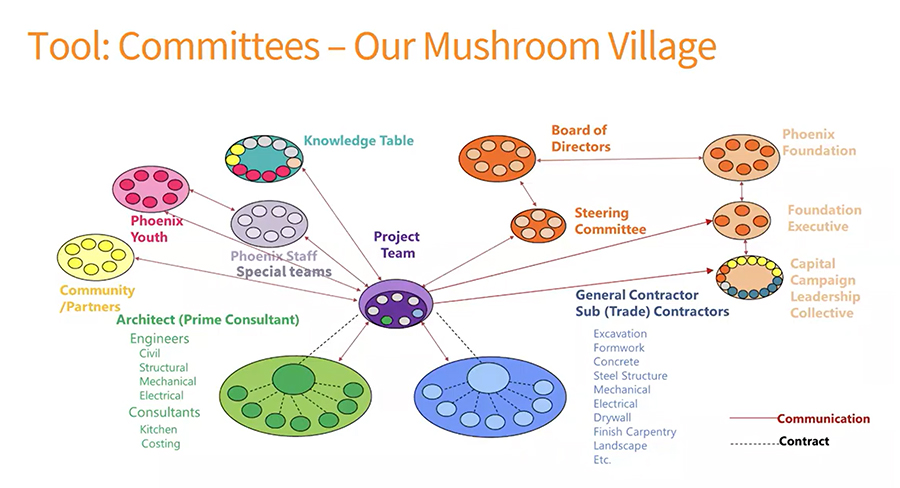
A central component of this structure is the Knowledge Table. The Knowledge Table brings together youth, frontline staff, and community members who meet regularly to engage with the project. Participants are compensated for their time and supported to review and discuss planning and design materials, including drawings and spatial concepts.
Benjie Nycum emphasized that structure plays a key role in sustaining meaningful engagement. Rather than relying on one-time consultation, the Knowledge Table was designed as an ongoing forum that connects input to decision-making over time, allowing lived experience to inform decisions throughout the pre-development process and supporting continuity as the project evolves.
Risk analysis
Risk analysis was treated as an integral part of pre-development. Phoenix used a structured risk register to identify potential risks across different aspects of the project.
Each risk was assessed based on likelihood and potential impact, allowing the project team to prioritize attention and identify response strategies such as avoidance, mitigation, or acceptance. Responsibility for monitoring risks was also clearly identified.
The risk register is revisited regularly and integrated into reporting processes with external consultants. As circumstances changes and new information emerges, risks and response strategies are reviewed and adjusted. Mel Sturk described this process as a way to stay grounded as conditions change, noting that having agreed-upon strategies help the team respond when unexpected issues arise.
Space considerations
Space considerations were integrated early into pre-development thinking. For Phoenix, this involved exploring how housing could function as a home while existing alongside shared service and community spaces within the same development.
Design conversations addressed privacy, safety, and a sense of calm, as well as access to services and shared areas. Concepts such as a community-porch-home were used to think through how residents might engage with shared spaces while maintaining separation, privacy, and choice.
Design ideas were allowed to develop alongside site selection, budget considerations, and feedback from participants, rather than being finalized at an early stage.
Onboarding external teams
External consultants and partners played an important role in pre-development. Phoenix emphasized alignment between internal priorities and external expertise when working with consultants.
Selecting consultants who demonstrated an interest in the project and a willingness to work collaboratively strengthened the pre-development process. Formal contracts and clearly defined roles were used to establish expectations and responsibilities, particularly at transition points such as moving from planning into detailed design. Benjie Nycum noted that while trust is essential, clarity around roles and agreements helps sustain collaboration as projects become more complex and timelines extend.
Learning from pre-development
The Phoenix experience demonstrates how pre-development work can be approached through structured tools, clear governance, and sustained engagement. The processes outlined here show how organizations can clarify priorities and support decision-making during early project phases.
By sharing approaches to vision development, site identification, risk analysis, committee design, spatial planning, and collaboration with external teams, this resource offers practical insight for organizations considering community housing initiatives.
This webinar is part of the Centre knowledge sharing series: a collection of short, practical learning sessions created for non-market housing providers. Explore upcoming and past webinars focused on housing systems and operational realities across Canada.
Want to learn more about pre-development or other community housing topics?
Visit our Resource Inventory! This service offers you a selection of tools and knowledge, such as:
- The CMHC development checklist for affordable housing, a four-part outline to plan your housing project, including the Part 3 focusing on pre-development.
- The 2nd edition of the Rural Development Network’s step-by-step development guide, to help groups who want to develop, build, and operate affordable housing.
- Tools from the Youth Homelessness Community Planning Toolkit, giving practical advice and illustrating the process of work plan and budget development.
- And many more.
Feature image from ©Phoenix Youth Programs