
In September 2025, Alison Lair and I had the opportunity to join a study tour organized by the Canadian Housing & Renewal Association and CIH Canada. We spent five days in Helsinki exploring a reality that still defies expectations: Finland is the only country in Europe where homelessness has been steadily declining for nearly forty years.
Together with thirty Canadian housing leaders, we visited eight sites, met frontline teams, and examined a system built on a simple conviction: ending homelessness is a political and social choice, grounded in the belief that housing is a human right.
Since the 1980s, Finland has developed a coherent social architecture anchored in three pillars:
- A large and stable supply of affordable housing
- A rigorous, nationwide implementation of Housing First
- Integrated governance between the state, municipalities, and community organizations
A national model built to last
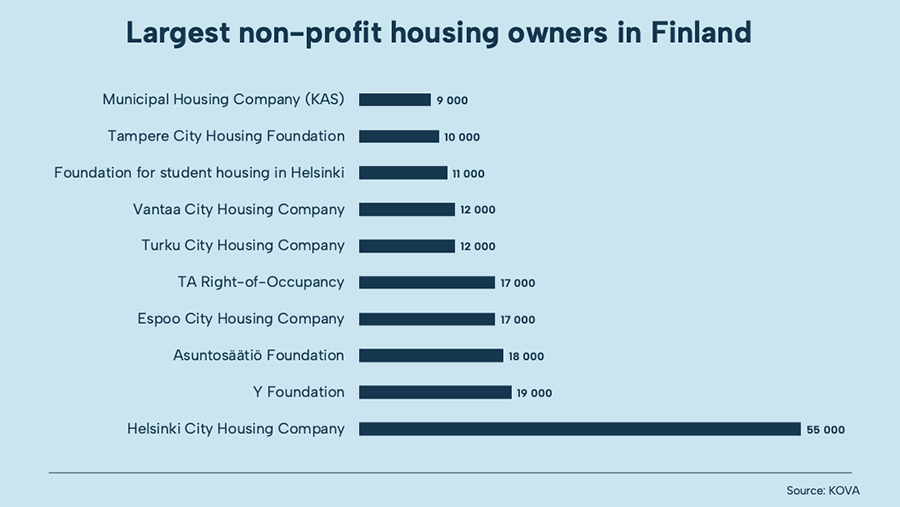
Finland has roughly 400,000 community and social housing units, representing about 11% of its entire housing stock. In Helsinki, close to 20% of all homes fall under the public or community sector. HEKA, a company fully owned by the city, alone owns and manages nearly 55,000 of these units.
Because the city controls roughly 70% of the land within its boundaries, it can shape urban development in a coherent way and set clear expectations for social mix and affordability. This land stewardship approach supports long-term stability rather than reactive crisis management.

Housing first: A national shift with no half measures
In 2008, Finland implemented Housing First at the national level. No pilot projects, no test cities, just a complete transformation of the system.
Three key decisions made this shift possible:
- Converting shelters into permanent housing. Helsinki closed its large emergency shelters and replaced them with buildings offering permanent homes and long-term support.
The Salvation Army’s evolution is a striking example: once operating the largest shelter in Northern Europe (with up to 500 beds), it had fewer than 100 beds by 2012, before converting the entire facility into 81 permanent units. This dramatic reduction reflects the system’s impact: fewer shelters were needed. - Training staff at scale, moving away from conditional, behaviour-focused approaches toward a rights-based model grounded in tenant dignity and protections.
- Setting clear national goals. Finland made an explicit commitment to eliminate chronic and long-term homelessness.
As Juha Kahila from the Y-Foundation put it: “We went all-in. No pilots, no temporary projects: a systemic shift.”
This level of political commitment broke through municipal resistance, accelerated investment, and provided the sector with a clear, unified direction. Today, visible homelessness in Helsinki is almost nonexistent. People experiencing homelessness are connected immediately to permanent housing with support, not diverted into emergency systems.

Behind Housing First: A complete ecosystem
The tour revealed a wide range of specialized actors, each playing a distinct role along the housing–support continuum. The State sets housing policy and finances construction through interest-subsidized loans, guarantees, and investment grants. Municipalities plan land use, own or manage most non-profit housing companies, and allocate dwellings. Tenants pay cost-based rents—on average 21% below private-market levels—and can receive housing allowances from the Finnish social security institution, Kela, to help cover housing costs.
This diversity is one of the system’s core strengths: it ensures that no group is left behind.
NAL: Preventing youth homelessness
NAL (the Finnish Youth Housing Association) develops affordable homes for people aged 18 to 29 and provides intensive support to young people transitioning out of child welfare services. Operating in 30 cities with 4,500 units, NAL is considered a relatively small actor within Finland’s housing ecosystem, yet its preventive impact is substantial.
Y-Foundation: The national pillar
As the fourth-largest housing provider in Finland, with nearly 20,000 units, the Y-Foundation is a cornerstone of the country’s Housing First transformation. Its integrated model combines publicly financed acquisition and construction, tenant services, eviction prevention, employment supports, tenant committees, and research. It also coordinates the national Housing First network.
Its strength rests on a simple principle: a large and well-funded public and community housing supply is essential to reducing homelessness.
Blue Ribbon: Intensive support and democratic governance
Blue Ribbon primarily serves people with long histories of homelessness, often alongside mental health or substance-use challenges. With 780 homes and 250 staff, the organization operates with profound humanism:
- a strong democratic culture where service users take part in strategic decisions,
- housing as a fundamental right,
- a clear rejection of paternalism,
- and very few conditions restricting access to services.
VVA/VEPA: By and for people with lived experience of homelessness
Founded by four people who had experienced homelessness themselves, VVA provides street outreach, accompaniment, eviction prevention, and a drop-in centre with no sobriety requirements.
Its summer house, located on an island accessible by free shuttle, is entirely self-managed by people experiencing homelessness and a handful of volunteers. This peaceful, green, autonomous space captures a central Finnish belief: dignity and autonomy matter as much as services.


What these organizations share
Despite their different missions, they all share three defining characteristics:
- Services are offered after housing, never as preconditions.
- They collaborate rather than compete, an institutional reflex that is rare elsewhere.
- They operate within a shared vision, coordinated both politically and administratively.
What Finland teaches us
This study tour revealed an ambitious, comprehensive, durable, and deeply human system. For nearly four decades, Finland has invested in a social architecture where affordable housing, social mix, individualized support, and public land management form an interconnected whole.
What we saw was not a collection of isolated projects, but a true ecosystem: a system where the State and municipalities plan for the long term, where organizations collaborate rather than compete, where lived experience is valued, and where public policy is designed to support stability rather than crisis response.
Finland shows that a country can achieve sustained reductions in homelessness when it commits to a clear vision—and equips itself with the tools to uphold it.
A model that could be reproduced in Canada?
Behind this exemplary system lie deep political, cultural, and institutional choices. Can Canada realistically draw inspiration from it?
Our next article on the Finish model will explore which of its parts could be adapted in Canada, which ones depend on unique local conditions, and where the limits lie despite the country’s impressive results.