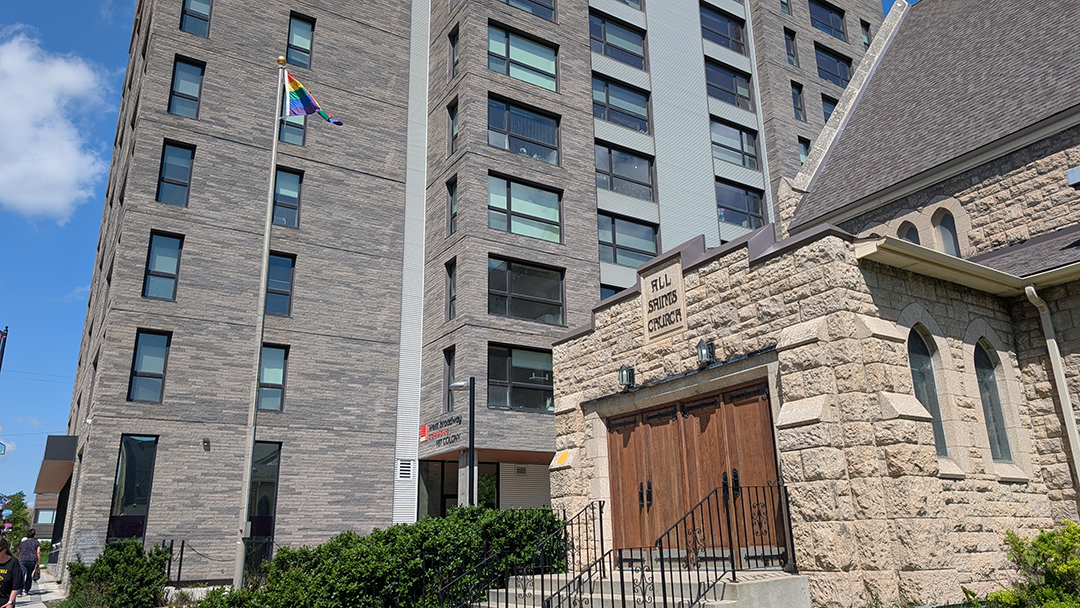
Across Canada, faith-based organizations own land and buildings with enormous potential to serve their communities in new ways. Churches, former rectories, vacant buildings and underused properties could become much-needed community housing, extending a long tradition of service while giving these spaces a renewed purpose.
But turning that potential into housing takes more than a promising site, a development plan or access to financing. It starts with people, relationships and trust. Faith-based organizations and community housing providers may share a commitment to serving their communities, but they don’t necessarily approach decisions, partnerships or property development in the same way. Their organizational cultures, priorities and expectations can be quite different.
Webinar | Working with faith-based organizations to create community housing
Faith-based properties offer exciting possibilities for community housing, but successful projects begin with strong partnerships. Join us to explore practical tools, real-world examples and lessons learned about building trust, aligning expectations and laying the groundwork for partnerships that can turn underused properties into lasting community housing.
December 10, 2026 | 1–2 p.m. ET / 2–3 p.m. AT
Register for the webinar
How do potential partners find common ground? How do they build confidence in one another, respect different ways of working and develop a shared vision? And how can they determine whether a partnership is right for them before investing significant time and resources?
These questions deserve attention long before the architectural drawings, financing arrangements and construction plans begin.
Building a foundation before breaking ground
Recognizing the importance of these early conversations, the Renewable Cities team at Simon Fraser University has been exploring what it takes to establish successful partnerships through its Building Housing on Faith-Based Lands project. The work was undertaken on behalf of the faith-based housing community of practice within CMHC’s Expert Community on Housing (ECoH).
The project’s first phase has produced the Pre-feasibility Framework for Facilitators Supporting Faith-Based Organizations, a practical resource designed to help those bringing potential partners together navigate the conversations and decisions that come before a formal feasibility study.
At its heart is a simple principle: a successful housing partnership needs a shared vision before it needs a development plan. That vision must reflect the missions, values and priorities of everyone involved, as well as the needs of the broader community. It means having candid conversations about who the housing will serve, how affordable it should be, and whether existing faith-based or community activities will continue on the property.
It also means understanding what each partner brings to the table, who will make decisions, and how responsibilities will be shared, not only during development but throughout the life of the housing. Just as importantly, the framework recognizes that faith-based organizations have their own decision-making processes, responsibilities to their members and long-term commitments. Taking the time to understand these realities, involve the right people and establish clear expectations can prevent misunderstandings and costly setbacks later.
Five questions worth asking before getting started
A promising property and a shared interest in affordable housing don’t automatically make for a successful partnership. The framework encourages potential partners to begin with a few fundamental questions:
- Why do we want to work together? What do we hope to accomplish, and where do our missions intersect?
- What matters most to each of us? What are our priorities, boundaries and non-negotiables?
- How will we make decisions and resolve disagreements? What happens when our perspectives differ?
- What strengths and experience do we each bring? Where might we need additional expertise or support?
- How will we navigate challenges together? Are we prepared to work through uncertainty and adapt as the project evolves?
The framework goes beyond simply posing these questions. It helps facilitators recognize encouraging signs, identify potential concerns and understand which decisions need to be made, and by whom, before moving into technical feasibility. The goal isn’t to eliminate every uncertainty at the outset. It’s to give potential partners the confidence and clarity to decide whether, and how, to move forward together.
Learn what makes these partnerships work
Renewable Cities and the Centre are putting the finishing touches on a training course that will explore these approaches in greater depth. The course will be available in the coming months. Subscribe to the Centre’s newsletter to hear when it launches. In the meantime, join us on December 10 for a conversation about the opportunities, challenges and practical realities of developing community housing on faith-based properties.
Leanne Sawatzky, Director of Renewable Cities, and Amal Abdullah, Project coordinator, will share insights from the research and introduce tools to help organizations build productive partnerships. Julie Lebrun, a retired Reverend, will join the conversation to speak about The Springs, a below-market housing project built on church land through a partnership between the church, a non-profit housing developer and a children and family services society. Dawn Campbell, Program Manager at the Centre, will moderate the discussion.
Part of the Centre’s Knowledge Sharing series, this webinar is for community housing providers, faith-based organizations, municipal representatives and community partners interested in exploring what these properties could become.
Whether you’ve already identified a potential partner or are simply wondering where to begin, you’ll come away with useful questions to ask, practical guidance and a better understanding of what it takes to move from a shared interest to a successful collaboration.
December 10, 2026 | 1–2 p.m. ET / 2–3 p.m. AT
The webinar will be offered in English and French, with simultaneous interpretation.