In housing and homelessness work, impact is often measured in units delivered and funding secured. Yet what ultimately determines whether that impact endures are the governance and financial decisions made behind the scenes. Board choices, revenue models, and risk management practices directly influence an organization’s ability to sustain, expand, and align its actions with its mission over time.
Connections for Seniors’ experience in Newfoundland and Labrador offers a concrete example of how a community-based organization can strengthen long-term stability through asset management, diversified revenue streams, and disciplined growth.
This article summarizes a recent session in the Centre’s knowledge sharing webinar series, focused on the organizational shift that enabled the transformation of $12,000 in seed money into $24.5 million in assets over eight years.
Addressing a structural blind spot: From service delivery to system design
Connections for Seniors was founded in 2018 by Mohamed Abdallah and Amanda Devlin to address a persistent gap in support for older adults experiencing homelessness. Through encounters in shelters and on the streets, it became clear that existing systems were poorly designed to respond to the realities of aging. Seniors were falling through the cracks of services not built for their needs.
The organization initially provided emergency shelter services but quickly recognized that this alone was insufficient to restore dignity. It shifted its perspective: rather than merely managing homelessness, it sought to help end it.
Connections for Seniors developed what Abdallah describes as a lifespan-informed support ecosystem: a coordinated approach tailored to the specific needs of older adults.
Connections for Seniors developed what Abdallah describes as a lifespan-informed support ecosystem: a coordinated approach tailored to the specific needs of older adults.
This vision aligns with the Housing First model, which notably enabled Finland to become one of the most effective countries in reducing homelessness.
Challenging the traditional not-for-profit model
Reflecting on the organization’s growth, Abdallah describes the traditional sector model as: “Grant-dependent. Short term. Risk-averse. Program boxed.”
In a program-centered model, success is measured against predefined deliverables within fixed timelines and budgets. While this logic ensures compliance, it limits strategic thinking and the capacity to address structural causes.
Over time, this dynamic positions organizations primarily as implementers of government priorities. Housing providers become program managers rather than long-term strategic leaders. The risk is clear: drifting from funding cycle to funding cycle and losing sight of the original mission.
As Abdallah puts it, “You cannot solve 21st-century problems with 1980s operating logic.” Moving beyond short funding cycles requires adopting a more systemic approach grounded in a clearly defined mission.
This shift begins internally. It involves adopting an entrepreneurial posture rather than positioning organizations as passive beneficiaries. It means building partnerships with funders instead of remaining in a logic of dependency. Housing providers must manage revenue and assets strategically, plan for the long term, and fully embrace structured risk management.
Abdallah advocates for a socio-entrepreneurial sector where profit serves purpose. This approach is grounded in strategic financial management and asset development. It strengthens implementation capacity, consolidates organizational resilience, supports strategic independence, and protects the mission from drift.

Revenues, assets and strategic economy
The socio-entrepreneurial posture took shape through a deliberate revenue and asset development strategy. From an initial capital of $12,000, the organization has grown to manage approximately $24.5 million in assets.
The same logic guides its goal of reaching 60 percent independent revenue to reduce vulnerability to shifting public priorities and ensure the sustainability of core services beyond individual funding cycles.
A concrete example occurred when the organization received time-limited funding. Rather than exhausting the allocation within a short program cycle, Connections for Seniors secured approval to invest in a revenue-generating asset: an event space that now supports programming while generating recurring income. A temporary funding opportunity thus became a long-term capacity-building decision.
Revenue diversification and asset management are therefore positioned as instruments of sustainability and strategic independence rather than ends in themselves. However, this strategy introduces another reality: growth entails risk. Asset development, expansion of housing supply, and reduced financial dependency require informed risk-taking and gradual scaling.
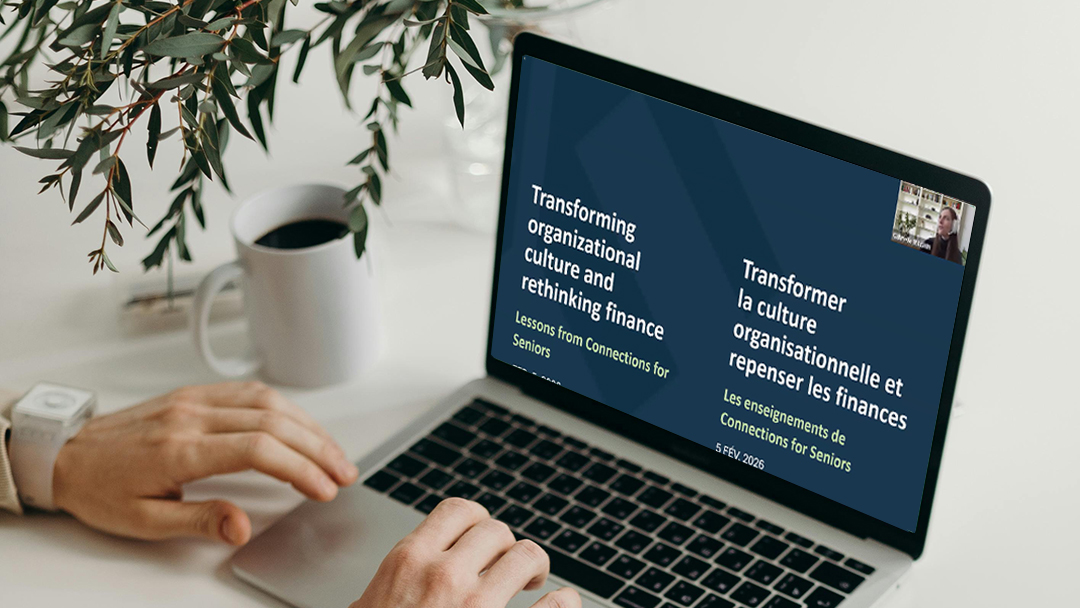
Webinar Transforming organizational culture, rethinking finance: Lessons from Connections for Seniors
Risk, scaling, and capacity building
Abdallah emphasizes that risk is inherent to growth and must be managed rather than avoided. In his view, an excessive fear of risk can prevent organizations from moving beyond incremental change. Every step toward asset development, scaling housing, or restructuring funding models carries legal, financial, and operational uncertainty. The question is not whether risk exists, but how to assess and mitigate it.
Connections for Seniors’ decisions are informed by both data and lived, frontline experience. Organizations closest to the issues possess knowledge that cannot be fully captured through metrics alone. Experience gained through service delivery and community engagement becomes essential in evaluating risk and determining when to act. Responsible growth does not eliminate uncertainty; it combines evidence, experience, and governance to move forward deliberately.
Abdallah describes this approach as asset-based thinking: anchoring growth in assets that reinforce mission stability rather than in short-term program expansion.
As housing units and services expand, organizations must ensure they have the governance mechanisms, financial oversight, and operational capacity required to manage them responsibly. Scaling becomes disciplined growth: expanding solutions while strengthening internal structures and maintaining mission focus.
Organizational governance and strategic discipline
Across these themes, one priority remains constant: protecting mission integrity. Growth, revenue diversification, and asset development are justified only insofar as they reinforce the organization’s core purpose.
The experience of Connections for Seniors illustrates that adopting a socio-entrepreneurial approach requires alignment at the leadership and governance levels. This shared understanding ensures that revenue diversification and asset development genuinely serve the mission. Programs remain tools in service of long-term objectives rather than ends in themselves.
Moving beyond grant dependency requires boards and executive teams to collectively recognize that, within a rigorous risk management framework, asset development and revenue diversification are inseparable from mission delivery.
Boards are naturally cautious. To evolve toward a more entrepreneurial model, they must distinguish unmanaged risk from strategic investment. Strong legal and financial oversight, along with clear accountability mechanisms, enable healthy growth that is fully integrated into the organization’s business plan.
Partnership and sustainability as responsibility
In this context, dialogue with government and funders is inseparable from the sector’s evolution. When organizations demonstrate strong governance, and rigorous day-to-day financial management, they reinforce their credibility as responsible stewards of public investment.
Abdallah also reminds us that “non-profit” does not mean an organization cannot generate a surplus. Surpluses must be reinvested in service of the community and the mission. Financial reserves and assets do not contradict the mission; they safeguard its sustainability.
Programs frequently end for reasons unrelated to community needs. Organizations lacking financial resilience may then be forced to reduce or abruptly close services.
Sustainability flows directly from this posture of stewardship. To act as credible partners and responsible stewards of public funds, organizations must ensure service continuity during funding transitions and protect community investments. They must also make sure growth strengthens the well-being of the populations they serve, rather than weakening it.
Moving from charity to sustainability ultimately requires a cultural shift. It calls for long-term vision, structured risk management, thoughtful asset development, and consistent alignment between financial strategy and human outcomes.
When these conditions are met, the sector strengthens its capacity to act not only as a service provider, but as a credible partner and long-term steward of housing solutions.
This article highlights a recent webinar from the Centre’s Knowledge Sharing Series. Explore past and upcoming sessions on housing systems and frontline realities across Canada.
Want to know more about social enterprises or other community housing topics?
Visit our Resource Inventory! This service offers you a selection of tools and knowledge, such as: