How can Canada sustain the long-term growth of community housing? To help answer this question, the Centre commissioned researchers Duncan Maclennan and Steve Pomeroy to examine what has supported or hindered the sector’s growth in six countries, and what Canada can learn from their experiences.
Their upcoming study, titled Get Going: Growing the Canadian non-profit housing sector, will resonate with many in the community housing sector: the housing crisis is about more than simply building new homes. Rising homelessness, growing pressure on renters, long waiting lists, and increasingly limited access to homeownership for young households all point to the need for a sustainable response that considers affordability. Beyond funding projects on an individual basis across jurisdictions in Canada, how can we create the conditions that will enable community housing organizations to meet the needs year after year?
For the researchers, a sustainable response requires looking beyond the number of homes funded each year. We also need to ask who will own those homes, who will protect their affordability, and which organizations will continue to create housing ten or twenty years from now. That is where community housing can make a meaningful difference over the long term.
Webinar | Get going: Growing the Canadian non-profit housing sector
What has helped community housing grow in other countries? Which approaches could work in Canada?
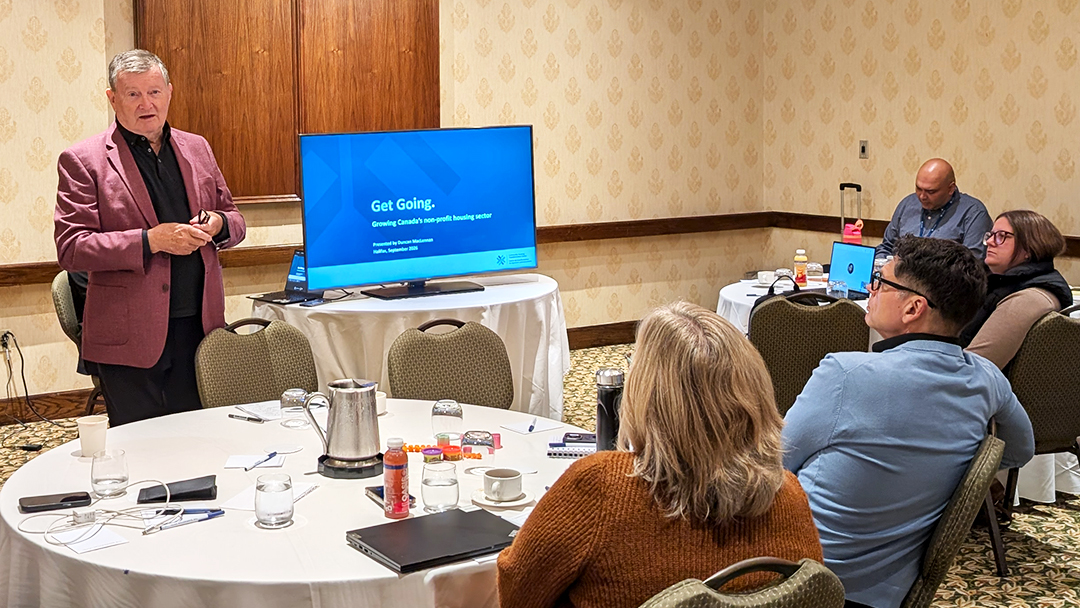
Join Duncan Maclennan and Steve Pomeroy, two researchers recognized for their knowledge and expertise in housing, as well as their understanding of housing policy, to explore key lessons from a study commissioned by the Centre. This discussion, moderated by Lisa Ker will examine what it takes to build a community housing sector capable of sustained growth.
November 26, 2026, at 1 p.m. ET
Funding homes or building a system?
Canada has long supported community housing projects. According to Maclennan and Pomeroy, however, funding one project at a time will not create the conditions for sustained growth.
Other countries have taken different approaches. The Netherlands and Denmark developed their systems over many decades. England and Scotland followed distinct paths within the same country. Ireland and Australia offer examples of more recent change. Comparing their experiences raises a useful question: what enables community housing organizations to grow, work together, and stay true to their mission over time? How do we create a system for Canada?
When organizations own homes and manage the income they generate, they have a foundation for maintaining their properties, planning investments, and pursuing new opportunities. Predictable financing helps them retain staff and move from one project to the next. Clear rules, strong governance, and reliable performance data can, in turn, build confidence among governments and lenders.
What could Canada do?
The authors bring the discussion back to Canada: which approaches used elsewhere could work here, and what would it take to put them into practice?
International experience points to a variety of approaches, but adapting them requires considering Canada’s existing institutions, different levels of government and their responsibilities, and existing sector organizations. The challenge is determining which elements can be adapted to the Canadian context and how they would be implemented.
Gathering better information about organizations, identifying those that are ready to grow, and supporting those that need to build their capacity first is an approach that can be carried forward.
Funding also needs a longer-term view. A ten-year growth strategy backed by federal, provincial, and territorial governments could connect new construction with property acquisition, the preservation of affordability, and the renewal of existing homes. Multi-year commitments would give organizations more certainty to plan for staffing, land requirements, and future projects.
Even with better financing, another question remains: how can providers offer genuinely affordable rents to households with the lowest incomes? Construction grants and low-cost loans cannot achieve this on their own. Stable rental and income assistance is also needed to meet the needs of these households which translates into more stable revenue for their nonprofit and cooperative landlords.
Room for different kinds of organizations
Growing the sector does not mean every organization must become large. Some smaller organizations play an essential role because of their deep knowledge of a particular neighbourhood, population, or region. Others want to develop projects on a larger scale or work across several regions. An effective system must recognize these different roles and ensure organizations have access to the expertise and partnerships they need to fulfill their mandates while contributing to the strength of the system as a whole.
This distinction matters especially in rural areas, where local resources for developing projects may be limited. It’s also relevant for organizations that already own housing, since preserving and renewing those homes is essential if new construction is to translate into overall growth for the sector.
A timely conversation
How can funding become less fragmented and shift from short-term, project-by-project investments toward more predictable, sustained funding that supports long-term planning and capacity?
How can organizations be supported between the delivery of projects? What mechanisms can protect existing homes while helping create new ones? And which international lessons can realistically be applied in Canada?
Duncan Maclennan and Steve Pomeroy will discuss what Canada can learn from these international experiences in a webinar moderated by Lisa Ker on November 26, 2026. The conversation is for community housing organizations, public and financial partners, and anyone seeking practical ways to strengthen the sector.