“If we don’t consolidate, we’re going to lose housing units.”
That blunt assessment comes from David Barbaza, Executive Director of the Fédération des OSBL d’habitation des régions du Bas-St-Laurent, de la Gaspésie et des îles de la Madeleine (FOHBGI), and co-founder of Logéco. It cuts to the heart of an issue often overlooked amid the broader housing crisis.
The latest installment of the Centre’s Knowledge Sharing Webinar Series highlights an innovative organizational consolidation model that is helping reshape the future of community housing from the ground up in rural Eastern Quebec.
While most conversations revolve around building new community housing, a quieter but equally urgent challenge is unfolding: preserving what already exists. Across the country, building new units isn’t enough if existing community housing continues to disappear due to a lack of succession planning, organizational capacity, or adequate building maintenance. That realization led the FOHBGI to create Logéco, an organizational consolidation model with the potential to inspire community housing providers well beyond Eastern Quebec.
Essential but vulnerable organizations
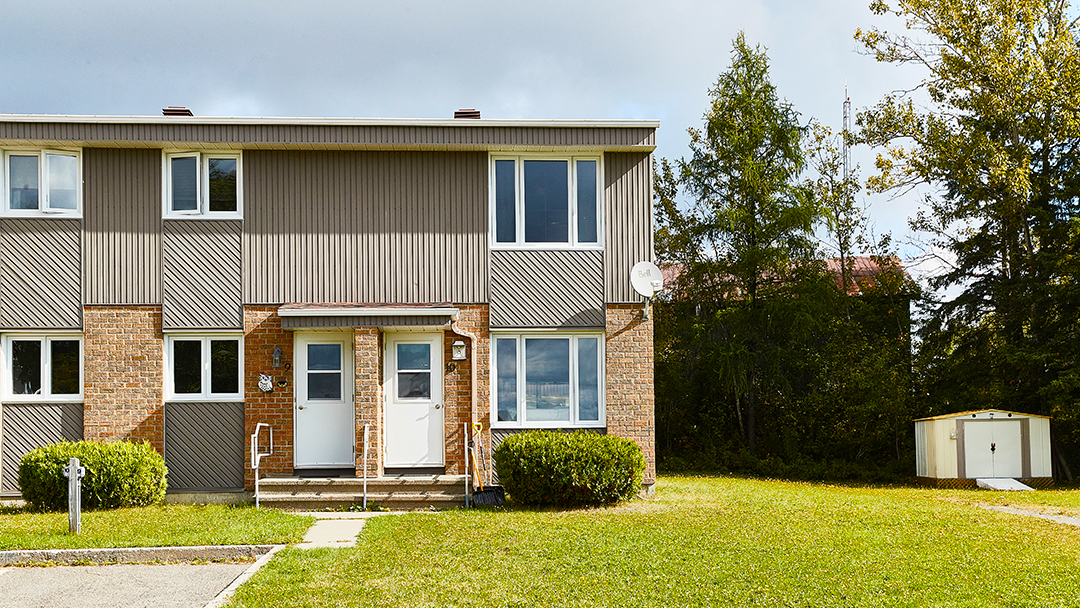
Community housing in Quebec relies on a vast network of small non-profits, deeply embedded in their local communities. In Eastern Quebec alone, the FOHBGI supports 125 member organizations that collectively own over 3,000 housing units, and 70 of those manage very small portfolios, ranging from 4 to 20 units each. This reality is not unique to Eastern Quebec. Community housing organizations across Canada face similar challenges: they play a vital role, but their small size often leaves them dangerously vulnerable.
The challenges are mounting: aging boards of directors, a dwindling pool of volunteer successors, and growing regulatory requirements, such as mandatory certification for seniors’ residences, which can come with hefty price tags. For many groups, simply keeping the lights on consumes all their energy, leaving little room to plan for the future. When an organization reaches a breaking point, the outcome is all too familiar: buildings fall into disrepair, doors eventually close, or assets are sold to private interests. Communities don’t just lose housing — they lose homes, local services, and a collective legacy built over decades.
Seeing this pattern repeat itself, the FOHBGI realized that one-on-one support wasn’t enough. It was clear that the model itself needed to be rethought. That’s how Logéco was born.
What is Logéco?
Logéco is a regional consolidation tool — not a lender, not a government program, but a practical, flexible mechanism that community housing organizations in Eastern Quebec can turn to for stability, strength, and long-term growth. As a real estate subsidiary of the FOHBGI, its mission rests on three pillars: consolidation, resource pooling, and development.
Consolidation means safeguarding what’s already there. When an organization is struggling, Logéco can step in to take over management, restructure finances, stabilize governance and, most importantly, ensure the organization’s housing units remain affordable at 25% below median market rent. No tenant gets displaced just because their housing non-profit is in trouble.
Pooling resources means shifting from isolated projects to a coordinated portfolio approach. Instead of each organization managing its own building, budget, and bookkeeping in a silo, resources are shared. One coordinator oversees multiple buildings, one accounting team supports several organizations, and bulk purchasing helps reduce costs. For volunteer-run groups in remote rural municipalities, this kind of shared expertise is transformative. Merging or transferring assets to Logéco is only one option, and it’s always voluntary. How resources are pooled depends on each organization’s unique situation and readiness.
Development becomes viable once consolidation is secured. Logéco uses the equity built up in its buildings as a lever for regional investment, financing renovations, acquisitions, and new construction without relying solely on government grants. “We’ve invested over $200,000 in renovations from our own funds. Ninety percent of our units have been renovated since we took over,” says Logéco’s founder. Development, then, flows from consolidation — not the other way around.
An organization’s journey with Logéco
The process never starts with a mandate. It starts with a conversation, often triggered by a concerned municipality or a worn-out board of directors unsure where to turn. Barbaza is adamant: “We never force anyone. We offer a tailored solution, and usually the organizations come to us.”
The first step is a strategic assessment built around five key areas: governance and board succession, financial vulnerability, building maintenance capacity, organizational isolation, and regulatory pressure (particularly in seniors’ residences). Each dimension is scored and given a risk rating. The goal is not to pass judgment, but rather to name what everyone already knows but hesitates to talk about.
Based on the findings, one of two paths is taken. If the organization has the potential to operate independently, the FOHBGI provides support to strengthen it. If the organization is too vulnerable, Logéco takes over through a four-stage process: establishing a new board, restructuring finances, realigning strategy, and pooling resources.
“You have to be patient. It takes time, and you absolutely must listen to and respect the organization’s pace,” says Logéco’s founder.. The emphasis on patience and respect is one of the key strengths of the model.
At the end of the process, three forms of integration are possible: sponsorship (the organization remains legally independent but Logéco handles management), acquisition (Logéco takes over ownership and management), or merger (full integration). Logéco itself has gone through five successive mergers since 2017, proof that the model has been tested and built through experience, not just conceived in theory.
What makes the model innovative and work
Logéco’s real innovation is conceptual: it has changed how we look at community housing portfolios. For decades, each non-profit treated its building(s) as standalone entities, looking no further than its own four walls. Logéco shifted that perspective, making visible what had always existed but had never been seen: a shared community housing portfolio across an entire region.This shift to portfolio thinking has a major financial payoff: dormant equity is unlocked and put to work. “Equity isn’t treated as something sitting idle in an organization. It’s a collective engine. It’s a structuring force for the whole region,” says Barbaza. Equity from a building in Rimouski can finance a renovation in Matane or an acquisition in Gaspésie. Community capital flows where it’s needed most.
But these structural innovations wouldn’t hold without a carefully considered human approach. As Barbazabluntly puts it: “Communication around consolidation and regrouping is 75% of the work.” That means meetings that run late into the night, repeated calls with local officials, and systematically anticipating concerns before they arise. Staff are hired first for their interpersonal qualities: empathy, active listening, and a non-judgmental appproach. Local roots aren’t just rhetoric. They’re written into the organization’s founding charter. In Témiscouata, Logéco houses and employs locals. For organizations in other regions, the same principle applies. Regional solidarity never comes at the expense of local identity.
Watch the webinar
What’s the takeaway?
Logéco can’t simply be replicated elsewhere. But its core principles can. Don’t wait for a crisis; identify vulnerable organizations before they reach the breaking point. Recognize that preserving is just as important as building new. Every community housing unit that is preserved is a real win, with no construction costs or delays. And understand that pooling resources can strengthen without erasing local identity, provided it is formalized from day one in founding documents, not just mission statements.
Logéco proves that even in regions far from major urban centres and with limited resources, it’s possible to build a model that preserves, unites, and endures. By doubling down on consolidation of the existing housing stock, Logéco offers a concrete, replicable blueprint for the community housing sector across Canada, a sector wrestling with the same pressures on its aging real estate assets.
How many other regions, federations, and organizations are hanging by a thread, afraid of losing a collective legacy built over decades of effort?
Logéco’s experience can help chart a path forward and lay the groundwork for the long-term consolidation of community housing. That foundation can become a powerful driver of future development while ensuring affordable, secure housing in rural and urban communities alike.
Ready to grow your impact?
Through our knowledge sharing series, discover proven models, practical tools, and bold ideas to strengthen community housing across the country.