After more than 50 years, Student Housing Nova Scotia’s (SHNS) was forced to reinvent itself to keep its mission alive when its agreement with a local university to run a 112-unit building came to an end.
“If you’re wondering how to find the money to make acquisitions, we were asking ourselves the same question.” — Mitchell Archibald, executive director of SHNS
Plenty of organizations ask that question. But it overlooks much of the work involved in bringing housing out of the private market.
SHNS’s story, shared during the September 22, 2026 webinar in the Centre’s Knowledge Sharing series, shows that securing a down payment is only part of the challenge. The rest involves knowing who makes the decisions, how quickly they can be made, what criteria guide them, and how to respond when an appraisal reveals something unexpected. For more context, read the introductory article about the webinar.
As Amanda Knight, the Centre’s moderator for the webinar, reminded attendees, buying a building means buying both a building and an ongoing operation, including tenants, leases, expenses, and upcoming repairs. The cause is social, but the purchase decision itself is a business decision.
Rebuilding to carry on the mission
Founded in the 1960s as a student initiative, SHNS, then called Halifax Student Housing Society,ran a 112-unit building on university land in Halifax for more than 50 years, providing housing exclusively for students. When the university announced the end of the agreement, the organization stood to lose its only asset and sole source of revenue. It subsequently changed its name and set out to rebuild a portfolio elsewhere in the province.
The process of starting over was far from glamorous: after transferring the building, SHNS was left with just one 11-unit property it had acquired shortly before.
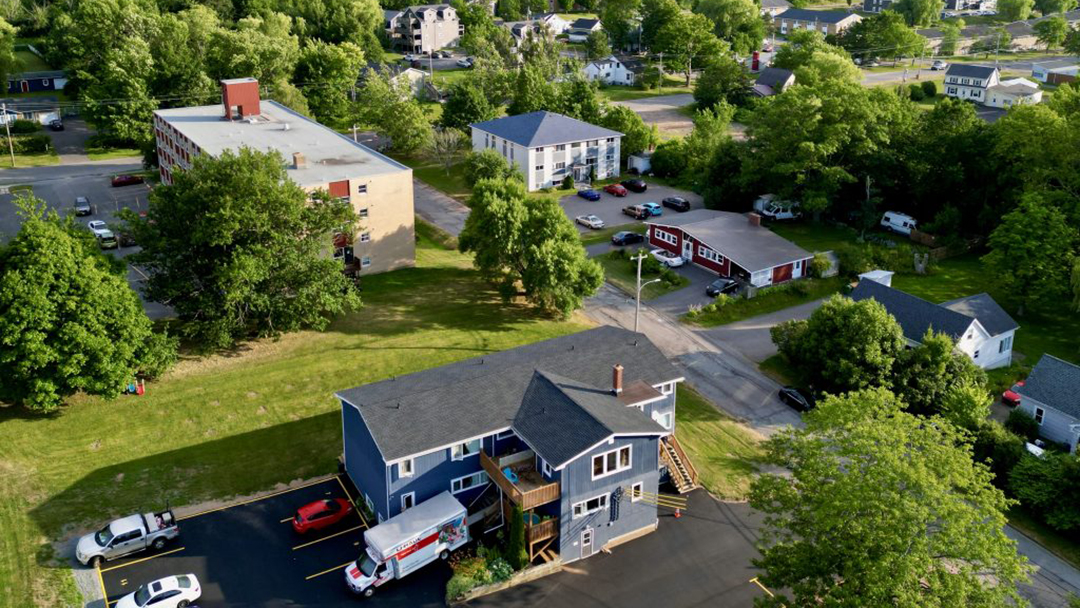
By the time of the webinar, the organization had 149 units across seven properties in the Annapolis Valley. A full year passed between its first and second acquisitions. For Mitchell Archibald, the lesson was clear: learn to tolerate risk and make decisions faster.
Making decisions quickly without losing control
Like other organizations across Canada, SHNS learned that good deals close quickly and often happen behind closed doors, sometimes without the organization ever hearing about them. Sellers generally won’t wait months for an organization and its board to make a decision.
As part of its new acquisition strategy, SHNS added members with expertise in real estate development and law to its board.
Four directors with backgrounds in engineering, urban planning, real estate law, and construction economics now make up an ad hoc development committee. According to Archibald, being able to consult this group between board meetings is a strength when it comes to making sound decisions more quickly.
With acquisition now central to SHNS’s business strategy, it has become routine. The executive director assesses opportunities and submits offers, while the board evaluates his recommendations. Establishing that balance took time, but it clearly gives the executive director more latitude. One condition makes this approach work: every offer includes an escape clause that can be exercised before due diligence ends. SHNS had its lawyer draft a custom offer template rather than use the standard form. A seller unwilling to accept that flexibility isn’t a good fit.
Finding opportunities before they hit the market
Of SHNS’s 149 units, only the first 11-unit building was acquired through a public listing. The rest came through relationships with brokers and property owners. A large share of its current portfolio came from a single transaction in which one owner sold his entire portfolio.
Archibald also met with a dozen brokers, giving each the same criteria: location, budget, and building type. In Nova Scotia. As with other jurisdictions in Canada, the seller pays the commission. His advice to other organizations: avoid exclusivity agreements and don’t hesitate to switch brokers if the relationship isn’t working.
Visible, well-managed acquisitions can help establish a community housing organization as a credible buyer with the experience and capacity to complete transactions. Over time, that track record can build confidence among real estate professionals, encouraging brokers, and sometimes property owners considering a sale, to approach the organization with new opportunities.
Compromises you can live with
SHNS’s criteria are clear: the building must be near a post-secondary institution, in good condition, and financially viable. Few buildings for sale meet all three criteria, so compromises are necessary, provided the acquisition serves the mission.
The building’s return has often been the deciding factor, since every property must also help cover the organization’s shared costs.
For example, SHNS purchased a 34-unit complex located a 15-minute drive from a college, where few tenants are students. The seller refused to sell it separately from other buildings that better matched SHNS’s criteria. What ultimately convinced the organization was the surplus generated by the building, which could be reinvested in the mission.
Buying also means inheriting tenants and their leases. SHNS treats non-student tenants like everyone else, respects security-of-tenure rules, and gives students priority only when units become available.
Know what you’re buying — and what comes next
Even when a deal looks promising at first, you must anticipate what could weigh on the operating budget later, because due diligence reports have their limits. For example, an inspection won’t necessarily flag a big increase in property taxes. Yet a building’s assessed value is often revised after a sale, potentially leading to a sharp increase in property taxes. Oil heating is another risk that calls for vigilance beyond the inspection. In one acquisition, SHNS required the seller to replace old oil tanks to avoid having to cover the cost itself. Depending on the price, the risks involved, and the appeal of the building, an organization may choose to negotiate, pay for extra tests, or walk away.
It’s also important to plan for future costs, such as roofs, balconies, and parking. Are major repairs expected in the short or medium term? Can they be spread out if the initial budget is tight?
A worn carpet can wait. Repairing a deteriorating roof that might leak cannot. Since initial cost estimates are often too low, SHNS now budgets about 30% more to avoid unexpected expenses.
Internal capacity and financing
For a community organization, becoming a real estate buyer is a tall order. Then comes the question of when to hire specialized staff. At SHNS, acquisitions still rest on two people — the executive director and the director of finance and operations — on top of their regular duties. After surpassing 100 units, SHNS hired three people in May 2026, although they were needed six months earlier. Budgeting for this capacity before expanding is essential to success.
Time being the scarcest resource, SHNS prepares as much as possible before an acquisition opportunity arises. It keeps grant and financing templates ready, so that only the property details need to be added.
The Centre also helped with grants to cover pre-purchase due diligence costs, such as environmental assessments.
Since financing can take weeks or even months, it’s important never to waive the financing condition before the funds are confirmed.
Then there’s the down payment, the biggest hurdle for many organizations. Several SHNS purchases were made possible by the Nova Scotia Community Housing Capital Fund, managed by the Centre. The fund isn’t permanent, so Archibald is advocating for continued government support of this kind. Over time, he says, it would make the sector less reliant on public money.
What other organizations can take away
Not everything applies directly: lease rules, property taxes, and financing programs differ from province to province. But the approach can inspire any organization in Canada looking to make acquisitions.
- Establish clear limits on management’s decision-making authority before you start looking for a building.
- Define your search criteria and share them with brokers and property owners in your area.
- Build your reputation as a credible buyer by sharing successful acquisitions. Demonstrating your ability to complete transactions can encourage brokers and property owners to bring new opportunities to you.
- Consider the full cost: taxes, heating, and repairs over the next ten years, with a buffer for unexpected expenses.
- Prepare your tools in advance: a standard offer template with a walk-away clause and grant applications ready to fill in.
- Plan for the staffing needs associated with acquisitions’ ongoing property management.
The ability to acquire properties is about far more than access to capital. It depends on a board that understands the strategy, clear criteria, trusted relationships, solid knowledge of what you’re buying, and the discipline to walk away when the numbers don’t work. For a community organization, real acquisition capacity can be essential to its survival, making it possible to offer affordable housing over the long term.
Ready to shift into high gear?
Watch the full webinar, “Buying beyond the listed market: Student Housing NS’s acquisition strategy,” and view the accompanying slides.
Explore the other models in the Knowledge Sharing series
Also read: Student Housing Nova Scotia: reinventing itself after 50 years.