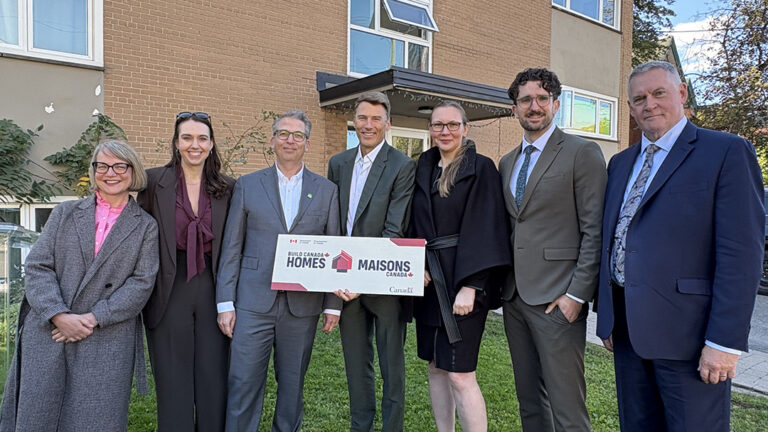

Three years ago, community housing organization Entre Nous Femmes Housing Society (ENFHS) had approximately 400 units spread across 11 buildings with a team of just six employees. Today, with a staff of 18, ENFHS manages 469 housing units and has another 500 units in development, expected to be completed by 2028. This transformation was not the result of chance, but a deliberate choice: strengthening the organization before pursuing growth.
This article is part of the Centre’s knowledge-sharing webinar series, which highlights promising approaches from organizations across the country. In this installment, Lilian Chau, CEO of ENFHS, joined Severn Nelson, Program Manager at the Centre. Their conversation looks back on the organization’s journey and, while rooted in the Vancouver context, explores challenges that many community housing providers across Canada will recognize.
The context behind the change
ENFHS’s story begins 40 years ago, when three single mothers in Vancouver, unable to find affordable housing for their families, decided to take action. With support from the YWCA, they founded their own organization and made use of federal programs available at the time to develop housing for single-parent families. This legacy continues to shape ENFHS’s mission: to provide affordable, secure housing, with a focus on women and gender diverse people, single-parent families, Indigenous peoples, and equity-seeking groups. Forty years later, the results are clear: a $230 million portfolio, 469 housing units, 13 buildings, and more than 1,200 residents in Greater Vancouver.
The turning point came in 2017, when Lilian Chau joined ENFHS with a clear mandate: to help the organization grow. Coming from the public sector and a background in urban planning, she stepped into a supportive environment. Canada had just launched the National Housing Strategy, new provincial programs were being introduced in British Columbia, and ENFHS’s board of directors was already exploring opportunities to redevelop some of the organization’s sites. But the organization also faced significant challenges. Many of its buildings were more than 35 years old and required major investments. Federal operating agreements from the 1980s and 1990s were coming to an end, while the housing crisis worsened and government funding remained uncertain. Faced with all this, Chau was clear: the organization needed to become much stronger financially. Remaining purely operational and managing the existing portfolio would no longer be enough to fulfill the organization’s mission.
A theory of change as foundation
Before launching new plans or projects, ENFHS first took the time to answer a fundamental question: why does the organization exist? This is the starting point for any theory of change, a tool used by many organizations to explain how and why actions will lead to outcomes. For ENFHS, this process took the form of a simple chain: if the organization provides safe, secure, and affordable housing to the populations it serves, and does so in a way that strengthens the sense of belonging and community ties, then it offers a stable foundation from which it becomes possible to open pathways to development.
In other words: secure housing leads to more stable lives for individuals and families, which in turn leads to stronger communities. Housing is not an end in itself, but a foundation. This exercise, though seemingly theoretical, proved highly practical: it enabled management to explain to both the board and funders why the organization does what it does. The entire strategy that followed flowed directly from this.
A four-pillar strategic plan, with a quantifiable goal
When Lilian Chau arrived at ENFHS, the strategic plan fit on one page, with a few broad statements that were difficult to translate into concrete priorities. The resulting 2023-2028 plan is of a completely different caliber. It sets a quantifiable goal — to double the impact by 2028 while maintaining real affordability — and is built around four pillars: maintaining and optimizing the existing property portfolio; growing the portfolio equitably by continuing to prioritize families with two- to five-bedroom units, even though they cost significantly more than studios; strengthening organizational capacity; and improving resident well-being. The second and fourth pillars are notable. In the case of unit size, two-to-five bedroom units cost significantly more than studios. With the fourth pillar, ENFHS does not provide any direct social services yet. It has chosen instead to support resident well-being by focusing on equitable access to housing and strengthening community ties.
The plan is also supported by a business plan. Each priority includes deliverables, a designated lead, a timeline, and a budget. The organization conducts a resident survey every three years and develops key performance indicators, such as vacancy rates and tenant turnover, to track progress beyond its annual reports.
Giving itself the means to grow
The most critical pillar of ENFHS’s approach remains organizational capacity building: the condition that made everything else possible. Even before Lilian Chau’s arrival, the board, historically composed of three members, had begun expanding to nine, recruiting experts in real estate development, finance, law, and governance. It was this same board that then hired her. The staff team grew from 6 to 18 people, with dedicated departments and a development committee composed of board members and external volunteers, tasked with analyzing each project before making recommendations, thereby freeing the board to focus on truly strategic decisions.
The guiding principle is clear: recognize what the organization already does well and seek out the skills it lacks. ENFHS drew on its accumulated reserves to fund 10 new positions, treating the organization as a social enterprise that invests in itself before its projects generate revenue. The signs of success are there: greater delegation, and an executive director who was able, for the first time in three years, to take a vacation without checking her email.
Partnerships became another major lever: moving from one-off funding relationships to genuine strategic partnerships with municipalities, BC Housing, Indigenous organizations, and community groups. A notable example is a project undertaken with M’akola Housing Society, one of the largest Indigenous housing societies in British Columbia. Together, they were able to strengthen their joint applications for funding and access to public land, where land costs remain one of the main barriers to affordable housing.
Diversifying for lasting change
On the financial front, the challenge is clear: 90% of ENFHS’s portfolio relies on subsidy agreements that are nearing the end of their terms. The organization’s response has several components: new subsidized projects, the acquisition of additional buildings, and the development of mixed-income projects whose surpluses help support the most affordable units in its portfolio.
The most notable innovation is a community bond pilot for the 800 Commercial Drive project. The concept: a charitable organization invites members of its community to invest in a bond with a fixed rate and term, essentially creating its own line of credit financed by the public. ENFHS aims to raise $3 million through contributions ranging from $2,000 to $20,000 for a mixed residential and commercial project, with the goal of repeating the model over multiple cycles to create a reusable fund. This model has already proven successful in Ontario, where organizations like Tapestry Community Capital help organizations structure bond marketing campaigns. The model is also gaining popularity across the country. Perhaps the most interesting detail is that ENFHS had been thinking about this project for three years and deliberately waited until it had the organizational capacity to move forward.
Transferable lessons
From this journey, Lilian Chau highlights three principles: build capacity before you need it; anchor growth in values and purpose by continually returning to the theory of change; and don’t do it alone, rely on partnerships and knowledge-sharing rather than competition. She adds a broader reflection: many small organizations may struggle to ensure their long-term sustainability on their own, and forms of consolidation or resource pooling may become more common as a way to share expertise that can be difficult to build internally.
Perhaps the strongest message is growth is as much a matter of imagination as it is of financial resources. ENFHS’s journey illustrates that growth only makes sense when it serves the organization’s mission and is only sustainable if the organization has taken the time to build the capacity needed to accommodate it. From the theory of change to community bonds, each step follows the same logic: establish the foundation first, then build upon it.
To hear Lilian Chau and Severn Nelson delve deeper into each of these elements, we invite you to watch the full webinar recording, as well as our previous article on ENFHS and the rest of our knowledge-sharing series.